4 Minute Read
Author: Megan Hayward, The Menopause Concierge®
The conversation about menopause leave has reignited recently in Australia.
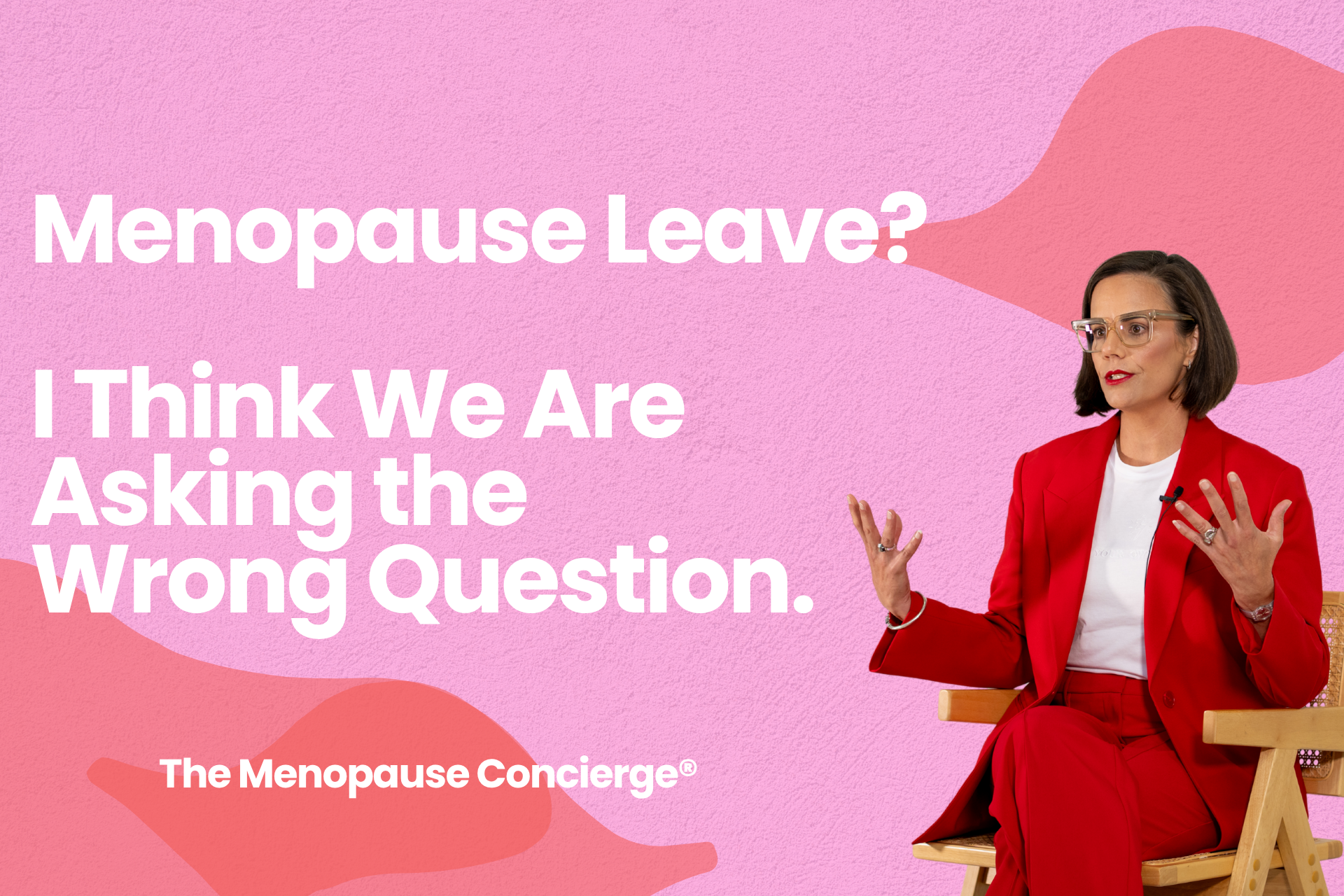
And while I welcome any conversation that acknowledges the impact menopause can have on women at work, I think we are starting with the wrong question.
The question should not be: Do women need menopause leave?
It should be: What do women need to successfully participate in the workforce through every stage of their biological lives?
There is a big difference between those two questions.
Menopause is not an illness. It is a biological transition. For some women, symptoms can be debilitating. I know, because I was one of the 20% whose symptoms were so severe they disrupted my daily life.
But with the right education, healthcare, early intervention, flexibility and workplace support, the majority of women can and want to continue working.
And therein lies the problem with creating a leave category specifically labelled menopause leave.
Women have spent decades fighting assumptions about their capacity to work, lead and progress. It was only in 1966 that Australia’s Commonwealth marriage bar was finally removed, allowing married women to remain permanent employees in the Commonwealth Public Service. This history is important, because it influenced every women’s economic participation.
We should be extremely careful about introducing policies that could unintentionally reinforce the idea that women, particularly those of us in midlife, are somehow less reliable, less capable or more likely to be absent.
The women who contributed to Australia’s landmark Senate inquiry effectively told us the same thing and the Committee heard mixed views about menopause-specific leave and reported that most submitters advocated for workplace flexibility and adjustments instead, noting that in most cases women require reasonable adjustments and flexibility to continue participating in the workforce.
I think it is particularly important to understand this:
Most women do not necessarily want to leave work. They want work to work better and to be supported in a way that helps them to do so.
That might mean a later start after disrupted sleep. A temporary change to shift patterns. Better temperature control. Access to a bathroom. Working from home when needed. Time for a medical appointment. A short micro-break to manage unexpected symptoms. Or simply a manager who understands enough to have the conversation safely.
The newly published ISO 45010:2026, the world’s first international standard providing workplace guidance on menstruation and menopause, reinforces this approach. It focuses on workplace design, policies, management practices, supportive mechanisms and practical adjustments that remove barriers to participation.
And for me, this is significant for another reason.
As a licensed Menopause Expert Professional with the Menopause Experts Group, I have been training organisations in exactly these areas for several years: how work is designed, how policies respond, how managers are educated, how conversations are handled and what practical adjustments can enable women to remain productive and engaged.
Menopause Experts Group has been leading menopause education internationally, and we strongly advocated for this same practical, workplace-focused approach in our submission to the Australian Senate inquiry.
So, seeing these principles now reflected in an international workplace standard is reaffirming. It has never simply been about giving women time off. It has always been about removing the barriers that make time off necessary.
That is also why I believe reproductive health leave absolutely has an important role. Not menopause leave in isolation. Gender-inclusive reproductive health leave. Because biology does not begin and end with menopause. And we certainly do not switch it off when we walk through the workplace door.
Endometriosis. Menstrual disorders. Fertility treatment. IVF. Miscarriage. Hysterectomy. Hormone treatment. Prostate screening and treatment. Preventative reproductive healthcare.
These are workforce realities, not fringe health issues.
Australia’s Senate Committee has already recommended further research into sexual and reproductive health leave while considering paid gender-inclusive reproductive leave within the National Employment Standards and modern awards.
That is a far more equitable and future-focused conversation.
It reflects what I call a biology-informed workplace.
A biology-informed workplace recognises that human beings are not biologically static across a 40 or 50-year career.
It does not give special treatment. It removes unnecessary barriers.
And internationally, this conversation is accelerating. Australia should be paying attention. Because the future of work will not be gender neutral. It will be biologically informed, inclusive and responsive.
So yes, let us provide reproductive health leave for the women and men who genuinely need it. But let us not mistake leave entitlements for the solution.
The bigger opportunity is designing workplaces where fewer people need to take leave in the first place.
Because when we design work with biology in mind, we do not lower the standard. We create the conditions for people to meet it, participate, lead and thrive.
#LinkedInNewsAustralia #MenopauseAtWork #Menopause #ReproductiveHealth #WomensHealthAtWork #FutureOfWork #WorkplaceWellbeing #GenderEquality #BiologyInformedWorkplaces